Shower Door Seal Glossary: Sweeps, Wipes, Lips and Jambs
Last updated: October 2026
Shower door seals go by many names: sweep, wipe, drip rail, lip seal, bubble seal, h-jamb, magnetic seal, glass-to-glass connector. This glossary explains each one so you can name the part you need. The name alone is never enough to order, though: add where the seal sits, the glass thickness and the gap, because different suppliers use the same word for different parts.
A to Z
| Term | What it means |
|---|---|
| Bubble (bulb) seal | A seal with a hollow, round section that squashes to close a gap; copes with uneven gaps |
| Closing edge | The edge of the door that meets a panel or wall when shut |
| Cross-section (profile) | The end-on shape of a seal; the most reliable way to identify it |
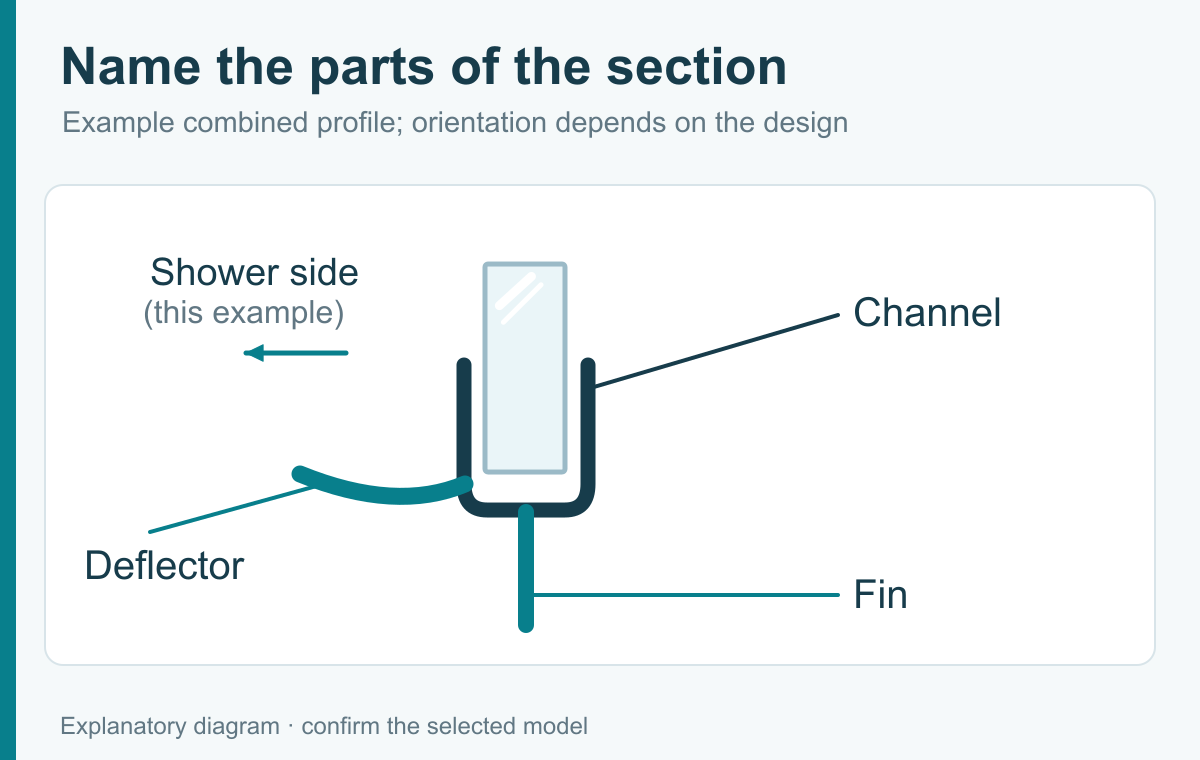
| Drip rail (deflector) | An angled section on the inside face of the door’s lower edge that turns runoff back into the shower |
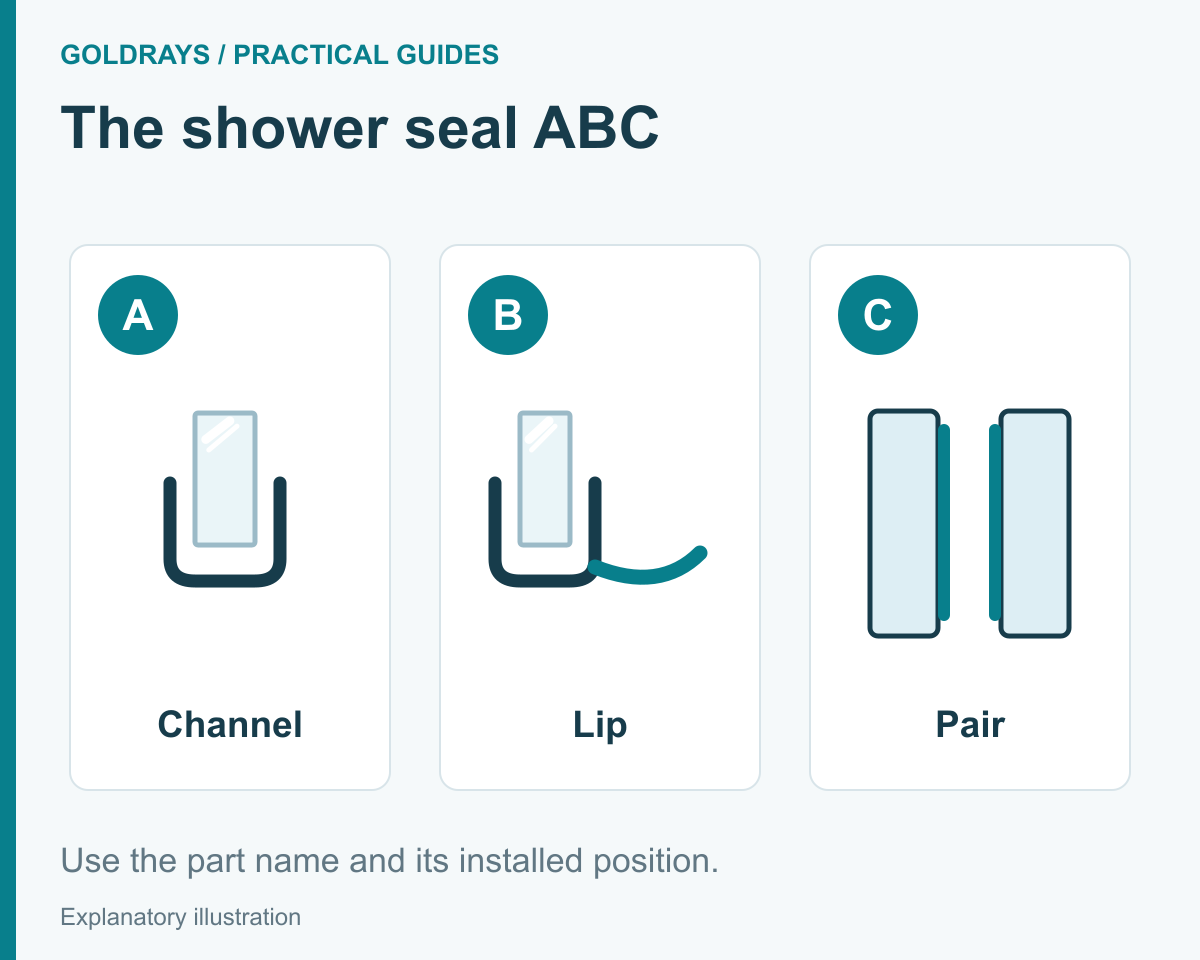
| Fin (lip) | The thin flexible part of a seal that touches the opposite surface |
| Gasket / glazing seal | A seal between glass and a frame or other component |
| Glass-to-glass connector | A seal joining two glass panels, at 90°, 135° or 180° |
| H-jamb | A wall or jamb profile with an H-shaped section; the glass sits in one side |
| Hinge-side seal | A seal on the edge next to the hinge or pivot |
| Magnetic seal | A pair of strips with magnets that pull the door closed; sold and replaced as a pair |
| Push-on channel | The U-shaped part of a seal that grips the glass |
| Rail insert | A seal pushed into a channel in an aluminium frame, not onto glass |
| Sealant (silicone) | A paste that cures in fixed joints; not a removable seal |
| Sweep | A fin along the bottom of a moving door that brushes the floor or tray |
| Threshold (dam) strip | A strip fixed to the floor or tray under the door |
| Wipe | Another name for a sweep or side seal: a sealing part, not a cleaning cloth |
Name the part by where it sits
Nicknames vary by country and by supplier. “Wipe” in one catalogue is “sweep” in another, and a “U seal” or “H seal” describes only the rough shape. Position is what tells a supplier what you need:
- Bottom: sweeps, drip rails, bubble seals under a moving door.
- Vertical edges: hinge-side seals, lip seals and closing seals.
- Inside a metal rail: rail inserts and glazing seals.
- Closing edge, pulled shut: magnetic pairs.
Similar names do not make parts interchangeable. DreamLine’s glossary distinguishes several of these functions, but one brand’s name doesn’t establish another’s equivalent.
Door seals are not plumbing seals
A gasket here seals an enclosure joint. It is not a tap washer or O-ring. Never use a door-seal offcut in a hose or valve connection; match plumbing parts to the fixture maker’s drawing.
Keep the measurements separate
- Glass thickness: the thickness of the pane the seal grips.
- Gap: the space the seal must close. A seal “for 8 mm glass” says nothing about the gap.
- Length: the run along the edge.
- Closed angle: the angle between panels when the door is shut (90°, 135°, 180°), not the angle the door opens. Pauli + Sohn’s profile range illustrates the distinctions.
Piece, pair or set?
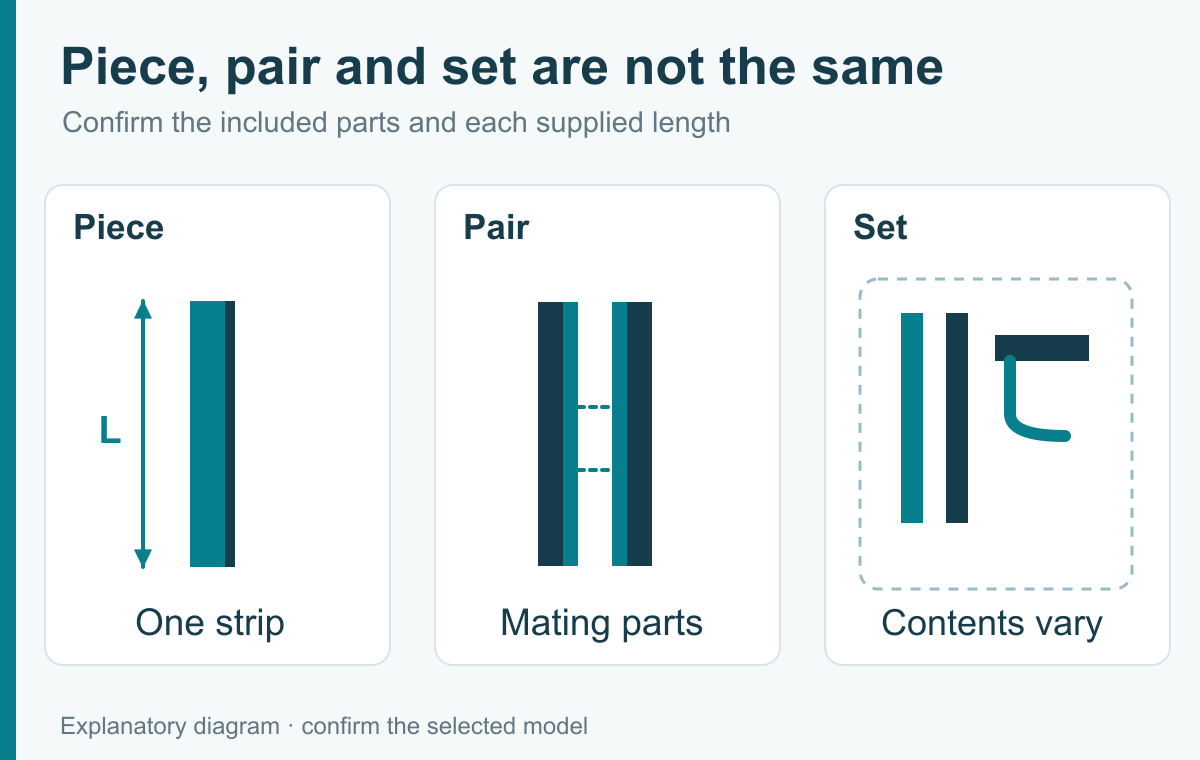
A piece is one length. A pair is two mating parts, as with magnetic seals; Bohle lists BO5213515 as one pair. A set depends on what the seller includes. Check the length of each piece and what is in the pack before comparing prices.
Four photos that identify any seal
- The whole enclosure.
- The seal in place on the door.
- The cut end of the seal, straight on, next to a ruler.
- A close-up of where it leaks.
A close-up on its own hides how the seal is installed. Add one sentence on how the door moves and the measurements above, for example: “Bottom seal for an outward-opening door; 8 mm glass, 6 mm gap, 900 mm long.” Our measuring guide shows how.
Trade buyers: send photos or an old sample and GoldRays will identify and match the profile. Contact us.
Frequently asked questions
What is a shower door wipe?
A sealing strip, usually a flexible fin along the bottom or side of the door. It is not a cleaning cloth.
Is a sweep the same as a drip rail?
No. A sweep closes the gap under the door; a drip rail turns water running down the glass back inside. Many bottom seals combine both.
What is an h-jamb on a shower door?
A wall profile with an H-shaped cross-section. One side fits over the glass, and the other side faces the wall or holds a seal.
About the author
GoldRays technical team
The GoldRays technical team writes these guides at the GoldRays factory in Foshan, China, where clear PVC and polycarbonate shower door seals have been made since 2001. The team works with more than 40 production lines and more than 3,200 moulds for 4 to 15 mm glass, and answers trade questions about fit, materials and testing.