Which Shower Seal Should I Buy? Start with the Position and Fit
Last updated: November 2026
Choosing a shower seal
Choose a shower door seal by its position, attachment and measured fit. Match the glass thickness, working gap, door movement and length. For a magnetic closure, also identify both mating profiles and the angle between the closed panels.
Find your seal type ↓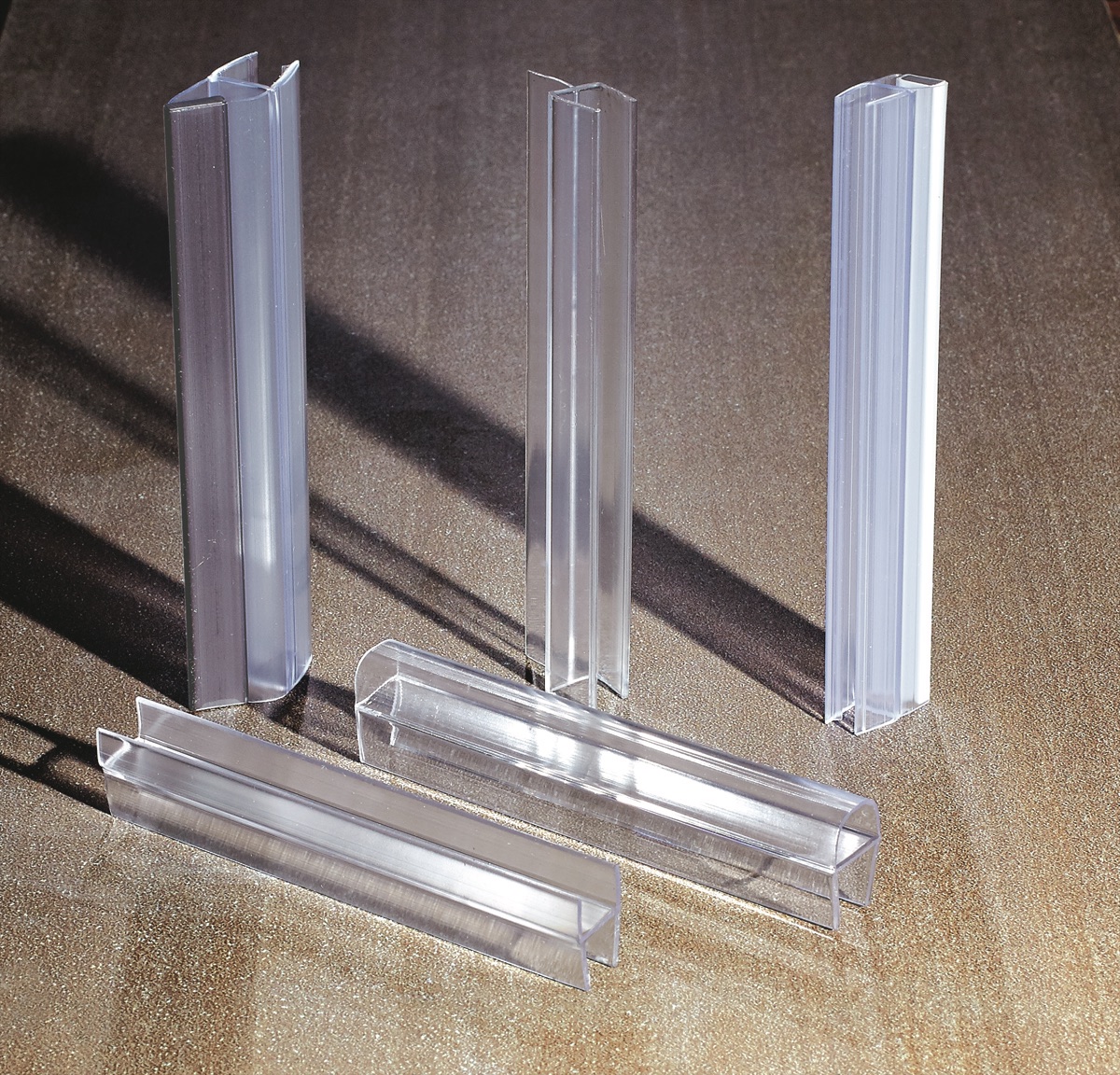
Watch the movement · step by step
How a clip-on seal grips the glass
Watch the channel meet the glass edge, then see the seated end section.
STEP 01 / 03
See the glass channel
The channel goes around the bare glass edge. This is a bottom clip-on example.
Watch source: Uniblade · 0:41–0:54 ↗Based on Inventive Creations’ Uniblade demonstration, 0:41–0:54. This is a bottom-seal example. Match your own part’s fixing and specified glass size.
01 · Look at the door
Where does the old seal sit?
Under the door
Look for a bottom sweep or water deflector. Match the glass channel and the space below the door; check that the flexible edge can pass the tray or threshold.
Along a side edge
Look for a side or contact seal. Compare the lip’s direction and reach, and show which surface it touches when the door closes.
Where two magnets meet
Identify both mating parts. Show the closed panels and how the door moves. Use the magnetic seal guide to check the pair.
Location illustrations only. A sealant bead at a fixed joint is a separate repair.
| Where the water or gap is | Type to compare | Check before selecting a profile |
|---|---|---|
| Under a moving door | Bottom sweep, sometimes combined with a drip deflector | Glass channel, clearance below the door and movement past the tray or threshold. |
| Water running down the inside face | Drip deflector | Direction of runoff. A deflector’s role differs from the flexible edge that closes the bottom gap. |
| A vertical hinge or closing edge | Hinge-side or contact seal | Which edge needs sealing, what the lip touches and the door’s opening direction. |
| Two edges that close magnetically | A matched magnetic pair | Both sections, closed angle, mating faces, polarity and the length of each strip. |
| Overlapping sliding panels | Sliding overlap seal | Panel overlap, lip direction and clearance as the panels travel. |
| A retaining groove in a frame | Frame insert or glazing seal | The retaining base and channel drawing, as well as the exposed sealing edge. |
Use the eight-type shower seal guide to compare these functions with bifold and other arrangements. Similar-looking sections are not proof of an interchangeable fit.
02 · Look at the fixing
Does it clip on or fit in a groove?
A clip-on section grips the glass edge. An insert slides into a retaining groove. An adhesive-backed design attaches to a surface.
Photograph the old seal’s end section and its mounting point. For an insert, include the retaining base; for curved glass, show the curve. Start with the enclosure maker and original part number when available.
03 · Take three measurements
Thickness, working gap and length
Glass thickness
Use the original specification or measure an accessible bare edge. Do not measure over the old plastic channel.
Working gap
Measure the space the seal must bridge at several points. Record which surfaces you measured between and whether the old seal was fitted.
Required length
Mark the start and end of each strip. Two mating magnetic strips may need different lengths.
An “8 mm glass” label describes the mounting size. It does not mean the seal will bridge an 8 mm gap.
Before you order
Compare the dimensioned end drawing with your old part. Confirm supplied length, permitted trimming and whether the pack contains one strip, both magnetic halves or an insert only. Check sample or return terms before cutting.
For a single replacement, start with the enclosure maker or a spare-parts retailer.
For a trade enquiry, specify each position separately
- Application: mark the door edge on a whole-enclosure photo and state how the door moves.
- Measured fit: give the glass thickness and working gap separately; include a straight-on end photo or dimensioned section drawing.
- Quantity: state each required length, the number of pieces and whether the enquiry is for single strips or complete magnetic pairs.
- Existing reference: include the enclosure maker and original part code if available. Treat another supplier’s code as an identification reference, not confirmation of an equivalent GoldRays model.
- Material and evidence: state the material or finish requested and any test requirement. Ask which report and sample scope applies to the proposed product.
Can I choose another supplier’s seal by part number alone?
No. Compare the attachment, dimensioned profile and working arrangement first. For a magnetic closure, check both mating parts. Confirm the proposed match with the supplier and a suitable sample before placing a production order.
Send GoldRays a trade specification →
Explore magnetic seal arrangements →References used for this guide
Shower Seal UK: identification and fitting help · DreamLine: enclosure terminology · MCOCOD: replacement measurements.
About the author
GoldRays technical team
The GoldRays technical team writes these guides at the GoldRays factory in Foshan, China, where clear PVC and polycarbonate shower door seals have been made since 2001. The team works with more than 40 production lines and more than 3,200 moulds for 4 to 15 mm glass, and answers trade questions about fit, materials and testing.